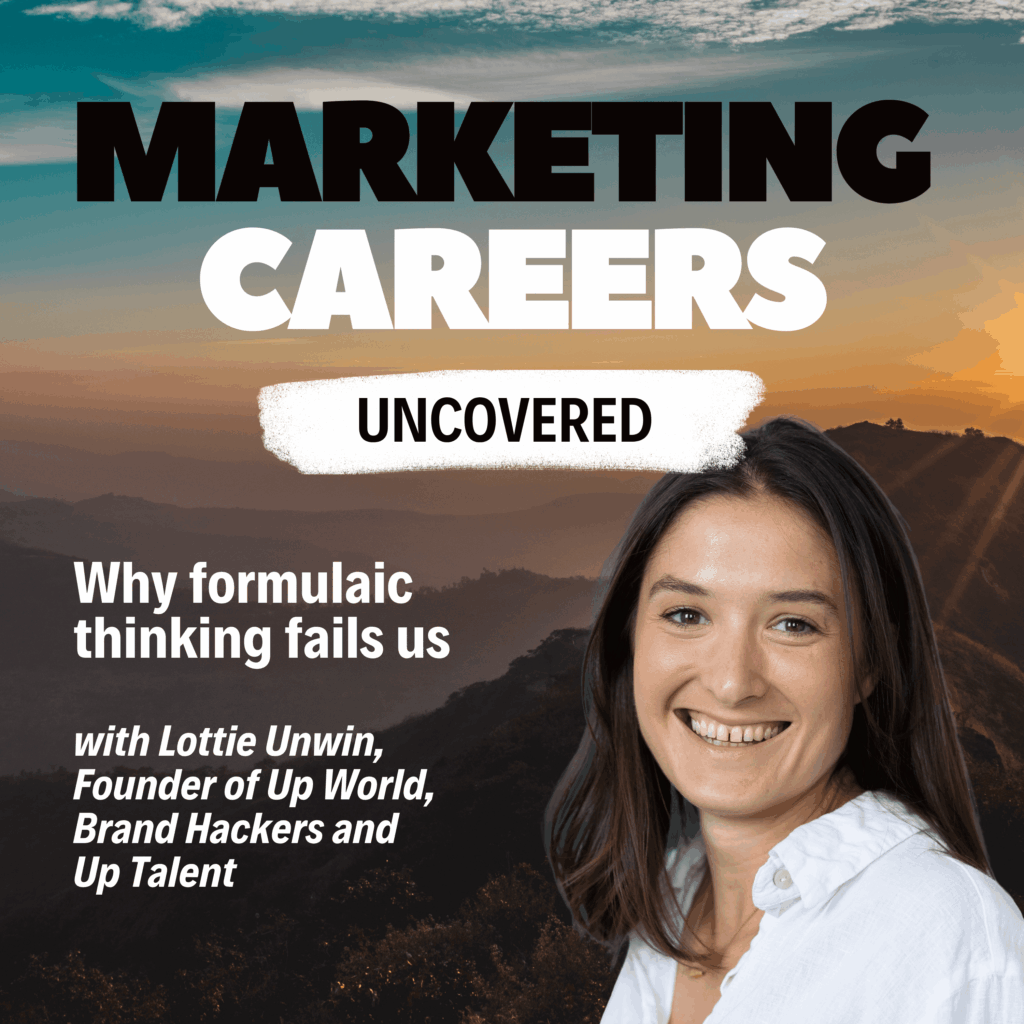
with Lottie Unwin,
Founder of Up World, Brand Hackers and Up Talent
Episode length: 19:31
Or listen and subscribe on




Subscribe to EXTENDED CUTS on Apple Podcasts (Spotify coming soon) for deeper dives into how real marketers think, act and lead
Is your marketing approach a roadmap or a straightjacket?
We’ve all been there. You spend weeks (and way too much mental energy) on a shiny strategy deck, following the textbooks approaches to the letter, only to find the business has moved on or the budget simply doesn’t exist.
In this episode, I’m joined by Lottie Unwin. She’s a self-confessed marketing geek who did the P&G rounds and took all the notes. But then she had to sell popcorn at a startup and the formulas fell apart.
We talk about:
- The formula failure: Why ‘Reach and Frequency’ is a luxury many of us can’t afford, and what to do instead.
- Climbing the mountain: Why focusing on ‘Pitch One’ is more important than the summit when you’re just trying to stay alive.
- Following the money: Why being ‘best mates with the CFO’ and knowing your runway is the only way to earn a seat at the table.
- The levers to understand: My own reflection on why two ‘identical’ businesses on paper require completely different playbooks.
Subscribe to get the Extended Cut – where we go deeper on managing leadership friction, how to interrogate a P&L, and my Day 1 networking playbook for spotting whether a culture is actually worth your time. And why your next campaign might actually need to be a hiring drive.
Full transcript
Lottie Unwin (00:00)
I started doing the maths on it and our budget was so small that there was literally no way I could deliver
to the size of the market I needed to hit my commercial targets. the formula broke because the budgets were so small. And that’s where you have to move into what I think are like a whole other set of levers.
Dave Heywood (02:28)
for anyone who’s not come across you before, you tell us a little bit more about you and what you do?
Lottie Unwin (02:30)
Yes!
Absolutely. I am Lottie. am passionate about startup marketing and all things marketing. And I have lots of views, as you may have heard, gathered. And I run three businesses. UpClub is a community for people in marketing and curated learning. Brand Hackers is fractional marketing teams for brands with limited resources and big dreams. And UpTalent is a marketing specific recruitment service. And I post a lot on LinkedIn and a little bit on TikTok on all things marketing.
So follow me if you haven’t come across me
Dave Heywood (03:01)
I’ve spent a fair amount of my career…
really being sort fanboying and advocating for, let’s call it the classical marketing framework, right? And what’s presented as the disciplined grown-up way of doing things where we go through diagnosis first, strategy and the whole, don’t let the tactics lead everything. Open up a fair few marketing textbooks, right? And that’s the viewpoint you get. That’s just how you…
do it and that’s how real businesses do it. But I think what I’ve often found and seen as well is loads of marketers out there, the expectation is move fast, you’ve got limited or no budget, even less resource backing you up. And when I heard you on a previous Upworld webinar where you advocated for slightly different approach and way of thinking.
Lottie Unwin (03:46)
Mmm.
Mm.
Dave Heywood (03:50)
I really wanted to test and stretch some of my own thinking too and discuss that with you.
Lottie Unwin (03:52)
⁓ Okay,
should I tell you the moment where I realised that everything I’ve been taught at Blue Chip might not work? Because this is where it all started. There was like, there was a moment. Okay, so I started my career at Procter & Gamble and like you, I mean, I am such a marketing geek. Like, I cannot think of a more fun way to spend my Saturday night than like…
watching a YouTube video and I’ve just got a new baby and so I don’t do anything else on a Saturday night and I’m fully fulfilling my wildest dreams of being that geek. so, so when I was at P &G, I was like the, in the front row of every training, I was the one that was like taking all the notes. I was so into it. And then I went to a startup and I remember so vividly, my brief was like basically sell more popcorn. i was at proper corn and it was a, like a really clear mandate. And I remember so vividly.
making my media plan, which was like, right, the principles of reach and frequency. So you’ve got to reach a number of people and you’ve got to deliver a certain number of frequency. And that’s how you move someone from, haven’t heard of a product, I’m interested in it. And then
I started doing the maths on it and our budget was so small that there was literally no way I could deliver a frequency of three to anything like, know, let alone the seven that I’ve been told was what we had to go for, let alone
to the size of the market I needed to hit my commercial targets. And it’s like the formula broke because the budgets were so small. And that made me realize that while the principles of reach and frequency make total sense, what startups have to do is drive disproportionate impact or make something, someone do something that at that moment is irrational. And that’s where you have to move into what I think are like a whole other set of levers.
⁓ around being disruptive around, like really disproportionately powerful storytelling, yada, yada, yada. But like, there was a moment where I realized that the textbook that I All into hook line and sinker and had kind of resigned from this big job saying, look, I’ve had the perfect training. I really am ready to take on any marketing challenge did not apply in a new environment. And then I had to start rethinking things.
Dave Heywood (05:58)
I guess if you just spent three months pissing about on strategy and doing everything very diligently, you probably get laughed out of a room or kicked out of a room pretty quickly going, what on are you doing? We’ve got product to sell here.
Lottie Unwin (06:11)
Yeah.
Yeah. And it’s that’s particularly pronounced when you’re at very early stage, like when you’re very early in market. So we’re doing some work at the moment for a sports nutrition product and it is six months old. And yeah, there’s the strategy deck we wrote, but the assumptions in the strategy deck very quickly come unstuck.
as you take the product into the real world, which is almost a given. Of course, they’re to be a bit right and a bit wrong, and you’ve got to respond to that. And therefore, just the navel gazing is so futile because it’s all so theoretical until you start putting the stuff out in the world.
Dave Heywood (06:49)
some of those, some of those principles and pressures, I don’t think are unique to the startup world. It’s any, it’s any, it’s any business that’s got a disproportionately small marketing budget or footprint or has quite extreme growth ambitions. So actually, yeah, you can take, you can take your pick of quite a few PE-backed firms that are anticipating that exact same veracity.
Lottie Unwin (06:55)
Mmm!
Dave Heywood (07:13)
Let’s call it But are we setting ourselves up for failure a bit by reaching for the approach and looking at well it works for You know the classic case studies that people wheel out Apple and I know the others who have who have the luxury of time and investment and actually if they get it wrong What really happens? Well the business doesn’t doesn’t sink overnight does it?
Lottie Unwin (07:38)
I know. mean, I’ve not been in a big business when a massive initiative has failed. I can imagine it feels pretty brutal if you’ve launched, if you’re at Unilever and you’ve launched a new Persil variant into a zillion stores and no one wants it because the strategy was completely wrong and you have to pull the whole line. I can imagine that feels pretty, pretty tough. But yeah, I don’t, I don’t want to be that brand manager. But
Dave Heywood (07:56)
yeah, it’d pretty brutal, wouldn’t it?
Lottie Unwin (08:00)
But what’s different in that environment is that it’s a one way door. Because of the power of the beast that you’re operating within, you have the opportunity to go out into 2,000 stores immediately. And so it’s a one way door. What’s different in early stage businesses is that it’s very often such a one way door because you can’t, because like momentum is more incremental than that. You don’t have these big, like big steps. And so so much can be done and undone.
or iterated on that I think again, like, yes, I really passionately believe in strategy in terms of making decisions to what you’re going to do and not do, but I think you need to be very careful of the time sink in strategy because so much can just be tweaked when it’s in the world.
Dave Heywood (08:40)
Yeah, and it’s built on a bed of assumptions anyway, which we know end up being wildly wrong anyway. So if the model that you came to the realization that the models and approaches that we held dear just really weren’t fit for purpose, how do you approach things now? Can you talk me through your sort of thinking?
Lottie Unwin (08:58)
Yeah. Yeah. So I think it’s
all about being very ruthless about what the next goal is and not worrying about the goals after that.
I have this metaphor that I use until i’m blue in the face of like climbing up a mountain. And if I think if you’re in a big business, you start at the bottom of the mountain, you say, I’m going to the top. I if you’re in a small business, that really doesn’t serve you because you forget that you haven’t even got to the first pitch. Like, and that is a huge challenge in and of itself. And so if you have a loose sense of where you’re going, I think…
in a small business, the only thing you need to do is recognise what has to be true when you’ve reached pitch one and you can like clip in and you’re safe for five minutes and you can take a breath and only think that far ahead. And so what that means in reality is, know, say you’re a snack bar and you’re trying to become like the most best selling snack bar in the UK.
If you’re in a big business, as I say, you go in, you get the 2000 stocking points, you have all the insights so that you know that your packaging is going to be right. And you kind of go this one shot at Landgraab and then you build brand perception from there. If you’re in a small business, the first goal might be to get five corner shops to stock your product.
That’s it. So then it’s like, right, well, what am going to do? I’m going to go and take a handmade cake to those five corner shops. I’m going to have a really nice chat with them. Great job done. What’s the next goal? The next goal is to get loads of people to buy that snack bar from those five corner shops. And you’ve got a great case study to take to other businesses. And then you approach it like that. So really, really carving up the steps and completely dismissing anything that is not going to affect that.
that end goal, which is the goal that’s going to keep you alive at each given point. And that I think is the huge difference. And so if I play that back to this kind of reach and frequency realization moment, I can’t go after reach and frequency because I don’t have the budget. So what do I need to do? I need to get 10,000 people to buy a bag of popcorn in Tesco’s in the next three months. Right. Well, reach and frequency isn’t going to do that for lots of reasons, because I don’t have the time to do that. So I need to think much more creatively.
about what’s the very standout thing that’s gonna just get a hoard of people into stores to do very specific job and then worry about unprompted brand awareness, worry about those like, yeah, like lagging metrics later.
Dave Heywood (11:16)
how do you sell in that approach to senior leaders or founders who might hear that approach and be forgiven for coming away with a sense that, well, it doesn’t feel very ambitious, Lottie. People expect to hear sort of big grand visions and we are going to get to the top of the…
top of the mountain. How’d you get that right?
Lottie Unwin (11:38)
It’s just the framing. It’s amazing. It’s just storytelling. It’s like, yeah, this is where we’re going. We’re going to the top of the mountain, but right now, but these are the steps that we’re gonna take to get there. And here’s how we’re gonna ladder them up. And actually the kind of founders I’m talking to are so aware of how tight their budgets and time are.
that I would say it’s the other way around. I’d say every time, like their lived experiences that everyone just tells them that they’re going to the top of the mountain, it’s going to cost them a number that they can’t get close to. And so for them, that’s deeply frustrating and like fundamentally just lacks insight and empathy as to what their world is like. So I’m pretty, I’m pretty candid in saying like, yeah, I understand what you’re trying to get to. And I fully believe we will get there. But I think
to respect where you are in your business and to make sure that I’m not wasting your money, which is like the one thing that they are most cautious about. We need to be very focused on doing the right things for you right now. So I’d say it’s, mean, if someone, if I’d say it’s, it goes down very well and when it doesn’t, it’s clearly not the right fit. And I’m very much okay with that.
Dave Heywood (12:40)
and does that take a particular set of skills or attitude from the marketer at the helm there? What’s not being taught from a skills perspective that people should really start picking up?
Lottie Unwin (12:53)
commerciality is the biggest thing. And I always coach on all the courses I run, like the way I frame it is follow the money, relentlessly follow the money. And that’s twofold. So the first, the first place you’ve got to follow the money is kind of short-term, like within the year. What cash is there? What’s runway? What, what has to be true?
to unlock the next bit of runway. So is that an interim fundraising goal? Is that you have to hit a certain revenue number in order to generate, in order for the business to be cash generating enough to be able to carry on operating as it is? That’s one like layer that I think marketers don’t understand. And that’s often because they don’t have the confidence to ask the questions. And I do understand, I do appreciate that they get rebutted a lot when they do start to dig there, but like,
you cannot dig hard enough, like without that perspective, I think you’re so blindfolded. And then the second layer of that is kind of end state financial reward. So basically people start businesses for, for cash and ego and a combination of the two. And so that cash is either going to be an exit at which point there needs to be certain things true of the brand to generate that exit number that the founder’s dreaming of. Or the, or the cash is in, ⁓
like money taken out of the business as the business grows. Understanding what motivates your founder and what has to be true of brand and marketing to fulfill that financial goal for them is key. And again, those are just questions that don’t get asked because we’re uncomfortable about money and because we don’t, it’s not assumed that we need to know this stuff. So I think we often don’t get let in the room, but being really tireless in your pursuit of like, I need to understand the P&L in full.
I need to be best mates with the CFO. need to feel, I need the founder to be confiding in me that they are worried about run rates, that they’re worried about their exit valuation. That’s the depth of relationship I think you need to be able to influence effectively.
Dave Heywood (14:42)
One of the best moments I’ve found to do that and build those relationships is day one, as soon as you come in, wide-eyed, bushy-tailed, you know, I want to meet as many people as possible and getting your claws in with finance and operations as well, I do think gets overlooked a lot.
Lottie Unwin (14:58)
Yeah
Dave Heywood (15:00)
the ultimate lesson here is, regardless of whatever doctrine you sign up to, plug yourself into every bit of the business and get a real understanding of what goes where and how a customer flows through your business.
Lottie Unwin (15:10)
Yeah, I love what you, yeah.
absolutely love
what you said about doing it as soon as you walk into a business, because I think it’s very hard to, like a lot of what I do is coach marketing managers on how they get used, like get ready for leadership positions. And I think a lot of their challenge is that they’ve cornered themselves. And if you don’t start asking those questions of ours, when you’re suddenly like all up in ops’ face, they’re like, but you’re, you do the social media posts, like.
Trying to reposition yourself is quite hard. It’s not impossible, but I think it’s hard. So I love your mantra of like, go in hot. Because if you establish that that’s what you are entitled to know, then that just becomes normal.
Dave Heywood (16:03)
on reflection, I think that in a lot of ways we were perhaps talking about the same thing. We were just using some slightly different language to describe it.
So actually we did spend quite a lot of time here talking about diagnosis as part of that strategic framework. And if you take that into a larger business or enterprise, yes, that is like a six week process that ends in a shiny sort of 50 slide deck that gets passed around the organisation like a joint. But Lottie’s sort of slightly screw…
hate to use the word scrappy, but you kind know what I mean. You’re a little bit more agile and fluid and that really ruthless immediate focus on what one or two things will actually move the needle this week, this month. I think it’s still diagnosis, right? It’s just the timelines are completely compressed and actually it’s probably the more honest functional.
form of that.
I’ve worked in businesses that on paper look very much the same. Same industry, similar size, same growth stage, same challenges. And yet each and every time I found that the levers I’ve had to pull to get a result were really, different. Some were about branding identity, some were about sales enablement, some were about actually building that functional engine from the ground.
from the ground up because they’d gotten this far without a marketing function and wants to take that to the next level. So all quite different. And now had I walked in with my exact same play, book and style and approach, I wouldn’t have lasted very long at all. That context is always absolutely, absolutely unique. And that’s something you can’t really.
You can’t really get from a template. You have to go into your organisation. You have to go and explore. Be quite ruthless about what’s actually going to make things move in the direction that we want them to.
So before you go and build that approach, I think we’ve got to really understand three things. So as we talked about the commercials, right? How does this business actually make money, stay alive and stay trading?
that runway as well. So how much time do we really have to mess about here?
And really clueing into that culture as well. How does the organisation actually behave? How do people work? How are decisions made? What kind of things do people value?
And that doesn’t mean that we shouldn’t have a long-term strategic viewpoint. But we’ve also got a really clue into what do I actually need to do right now, right this moment.
And with that in mind, thanks so much for listening. If you enjoyed today’s conversation, don’t forget to subscribe for future episodes, leave a review, or share with your friends and colleagues. See you next time.